
Education Builds Resilience
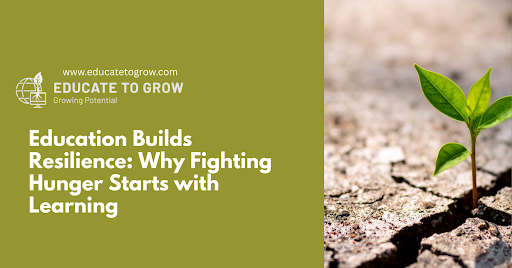
A bag of food can ease hunger today. The ability to read, plan, grow and earn can help a family face tomorrow.
When we discuss food security, we often focus on rainfall, harvests and prices. Yet another essential resource deserves attention: knowledge. A farmer interpreting planting instructions, a parent comparing food prices and a young person learning to manage a business are strengthening the same foundation.
Education builds resilience because it helps people turn information into decisions that protect their livelihoods. Connecting literacy, practical learning and food security is essential to building communities that can withstand hardship and create opportunity.
Hunger and Education: A Cycle We Must Break
Hunger makes learning harder. Children arriving at school without enough nutritious food may struggle to concentrate and participate. Adults facing food shortages often prioritise immediate survival over training or further education.
Limited learning opportunities can, in turn, restrict employment prospects, weaken earning potential and make useful agricultural information harder to access.
UNESCO’s work on education and nutrition highlights this relationship: education supports stronger food systems, while improved nutrition supports educational achievement.
Breaking the cycle requires connected action. School meals, adult literacy programmes, practical skills training and livelihood support can reinforce one another. Communities need opportunities to learn alongside the resources that make participation possible.
Literacy Belongs in the Field and the Marketplace
Literacy reaches far beyond reading a book. It helps people understand instructions, evaluate information and communicate their needs.
In agriculture, these abilities have practical consequences. Reading a seed packet supports planting decisions. Understanding safety instructions helps people handle agricultural inputs responsibly. Keeping records allows producers to compare costs, yields and sales across seasons.
Numeracy matters just as much. Calculating quantities, measuring water, comparing prices and understanding interest can influence whether a household or small enterprise remains financially stable.
UNESCO identifies literacy as a foundation for empowerment. Within food systems, that empowerment can mean asking better questions, recognising misleading claims and negotiating with greater confidence.
Education Builds Resilience Through Practical Skills
Learning becomes valuable when people can apply it to challenges they recognise.
A food garden offers opportunities to practise planning, budgeting, soil care and water management. A small agricultural enterprise creates lessons in customer needs, record keeping and cash flow. Food preparation sessions can connect nutrition knowledge with affordable, locally available ingredients.
The Food and Agriculture Organization’s farmer field school approach brings producers together to investigate problems and learn through observation and practice. It demonstrates how education can grow directly from everyday agricultural decisions.
Effective training also respects existing knowledge. Experienced growers and community members hold valuable insights. Combining these with accessible technical guidance creates learning that people can test, adapt and share.
Food Security Requires More Than a Harvest
Producing food is only part of the challenge. Families must also be able to obtain it, use it safely and maintain access over time.
The FAO’s food security framework identifies four dimensions: availability, access, utilisation and stability.
Education contributes across all four. Production skills support availability. Employment and enterprise skills can improve purchasing power. Nutrition and hygiene knowledge support safer food use. Planning and diversified livelihoods help households prepare for disruptions.
This is why education builds resilience across the entire food system. Its value extends from the field to the market, the kitchen and the household budget.
Make Learning Accessible to Everyone
Training cannot strengthen a community if the people who need it most cannot participate.
Cost, transport, language, disability, childcare responsibilities and limited connectivity can all create barriers. Programmes should consider local languages, flexible schedules, affordable delivery and opportunities to practise close to home.
Digital learning can widen access, but it needs realistic support. Downloadable materials, clear instructions and facilitated group sessions can make learning more usable where connectivity is unreliable.
Women, young people and adults returning to education should help shape these opportunities. Their experiences reveal what communities need and which barriers must be removed.
Invest in Knowledge That Lasts
Emergency food assistance remains essential during a crisis. Lasting food security also needs sustained investment in people’s capabilities.
Schools, employers, farmers, community organisations and public institutions each have a role. Together, they can connect learning with practical experience, mentoring and opportunities to earn.
Success should be measured through meaningful changes: stronger decisions, safer practices, improved livelihoods and greater household stability.
Growing a More Resilient Future
Education builds resilience when learning equips people to act. Literacy opens access to information; practical education helps turn it into better livelihoods and stronger food security.
For Educate To Grow NPC, this connection offers a compelling focus for community development. Investing in people’s ability to learn, produce and earn helps build a future in which fewer families must choose between today’s hunger and tomorrow’s opportunity.